

When I say history, I really mean minor footnotes to history. The Westminster Palace was the first ‘Grand Hotel’ in London not connected to a railway terminus and it manages, just, to appear in one or two of those footnotes. So, while a building on such a prominent site will always be of interest to Londoners keen on the history of their city, I fear that only Canadians, Indians, and students of terrible American actresses will join us in finding this a rewarding read. On the plus side, it is quite short.
The Westminster Palace Hotel Company was formed in 1857 to erect a hotel on a large, sort-of-triangular site opposite Westminster Abbey. The company’s prospectus suggested the building would have 200 bedrooms. By mid-1858 the site had been cleared of houses which themselves had only been erected some twenty years previously. This gave rise to some profitable recycling as the salvaged building materials were sold on.
However, after that, things began to go wrong.
There was, for a start, a gruesome discovery: The remains of four people at foundation level. It was believed these were related to the old Abbey almonry (its charitable office, responsible for distributing alms to the poor). Admittedly, digging down further did produce interesting finds, among them an ancient hard causeway leading towards the western gate of the abbey close, and a pilgrim’s hat made of goat’s hair.
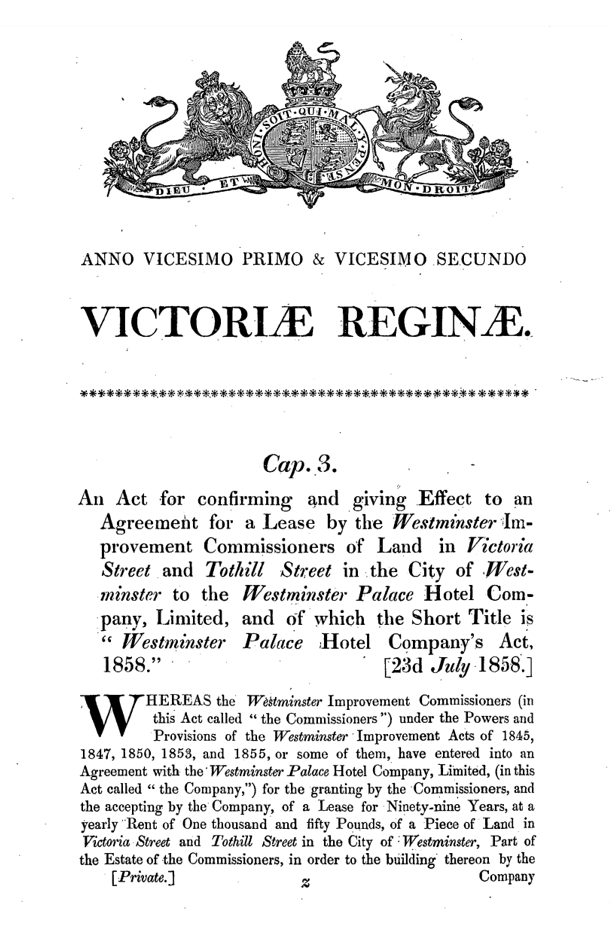
But these finds were soon overshadowed by legal issues over ownership of the land, which consisted of a series of individual plots. Building a hotel in London doesn’t usually require an Act of Parliament, but when the Westminster Improvement Commissioners of Land granted a 99-year lease to the company at an annual rent of £923 (£100,000 today), a series of legal actions by individuals and hospital governors suggested the commissioners didn’t have legal title over some of these plots. To overcome these issues, the company and commissioners had to push a private bill through parliament. In mid-1858 the Westminster Palace Hotel Company (Limited) Bill completed its passage and became law; this allowed the lease to be granted and construction to commence while legal actions continued.
← The title page of the Westminster Palace Hotel Company’s Act, 1858, as it is legally known. Lists of associated lawsuits, legal judgements and mortgages that made the Act necessary take up three pages of appendices.
The problems continued. The site was plagued by construction workers’ strikes throughout 1859. On the 13th of May that year, seven men were killed when a stage, 70 ft above ground level and designed to hold bricks and mortar for the bricklayers working there, partially collapsed. It transpired that the transoms had been overloaded and the wood used too knotty. It was reported with, I fear, some satisfaction at a half-yearly meeting of the company soon after, that “the late fatal accident had not cost the company anything as all the expenses and remuneration to the sufferers had been paid by contribution” (that is, public donations). Site safety didn’t improve; a sixteen-year-old died on the 1st of August. Paid to transport bricks around the site, he fell from a height of 80ft after “larking about” with other lads.
Then there’s the Caxton statue that never was. In the late-15th century, the famous printer William Caxton had a printing press in his house on the Tothill Street side of the site, and in 1859 it was reported that a statue of Caxton would be erected in the ‘Great Room’ of the hotel. By 1862 plans had clearly changed, with architect Andrew Moseley suggesting that “it is intended at some future time” to place a statue on the Tothill Street façade of the hotel. However, there is no evidence that a statue was ever commissioned for either location.
Not to worry. The hotel, built to designs by W&A Moseley, was ready to open in 1860 with luxurious facilities, one of the country’s first hydraulic lifts, pneumatic bells for room service, and – after the purchase of more land – 317 bedrooms. The architects claimed that the building “would possess at least some indication of ‘high art,’ untrammelled by conventionalities, and they may, perhaps, refer to the Mansard roofing as proof.” I have to admit that I personally remain unconvinced that a mansard roof can be compared favourably with other high art, such as a Rembrandt painting, but let’s put that to one side. The Moseleys also left a gap of 4ft 6 inches between the foundation flooring and the basement to allow for tidal water flowing up the drains, which seems wise. Sadly the lift, which required 4,000-gallon reservoirs at the top of the building, was not completed in time for the initial opening and was still inoperative two years later.
The number of bedrooms was also moot. Even before opening, the company had agreed to let part of the hotel – around 140 rooms, the entire western side – to the Government for seven years at £6,000 rental p.a. (£640,000): The India Office had taken over governing British India from the abolished East India Company after the Indian mutiny/rebellion, and needed better offices than those provided by the decaying company HQ on Leadenhall Street. Luckily, the design of the new building allowed the eastern half to function as a hotel on its own, as it contained the required public rooms – dining rooms, smoking rooms etc.
The letting resulted in a large number of newly-employed hotel staff being made redundant, which didn’t go down well, but this was clearly a profitable move even after construction costs had risen to £97,000 (over £10 million) due to necessary alterations. The India Office brought with it 227 tonnes of books which, the architects claimed, severely tested the load-bearing joists but did not find them wanting.
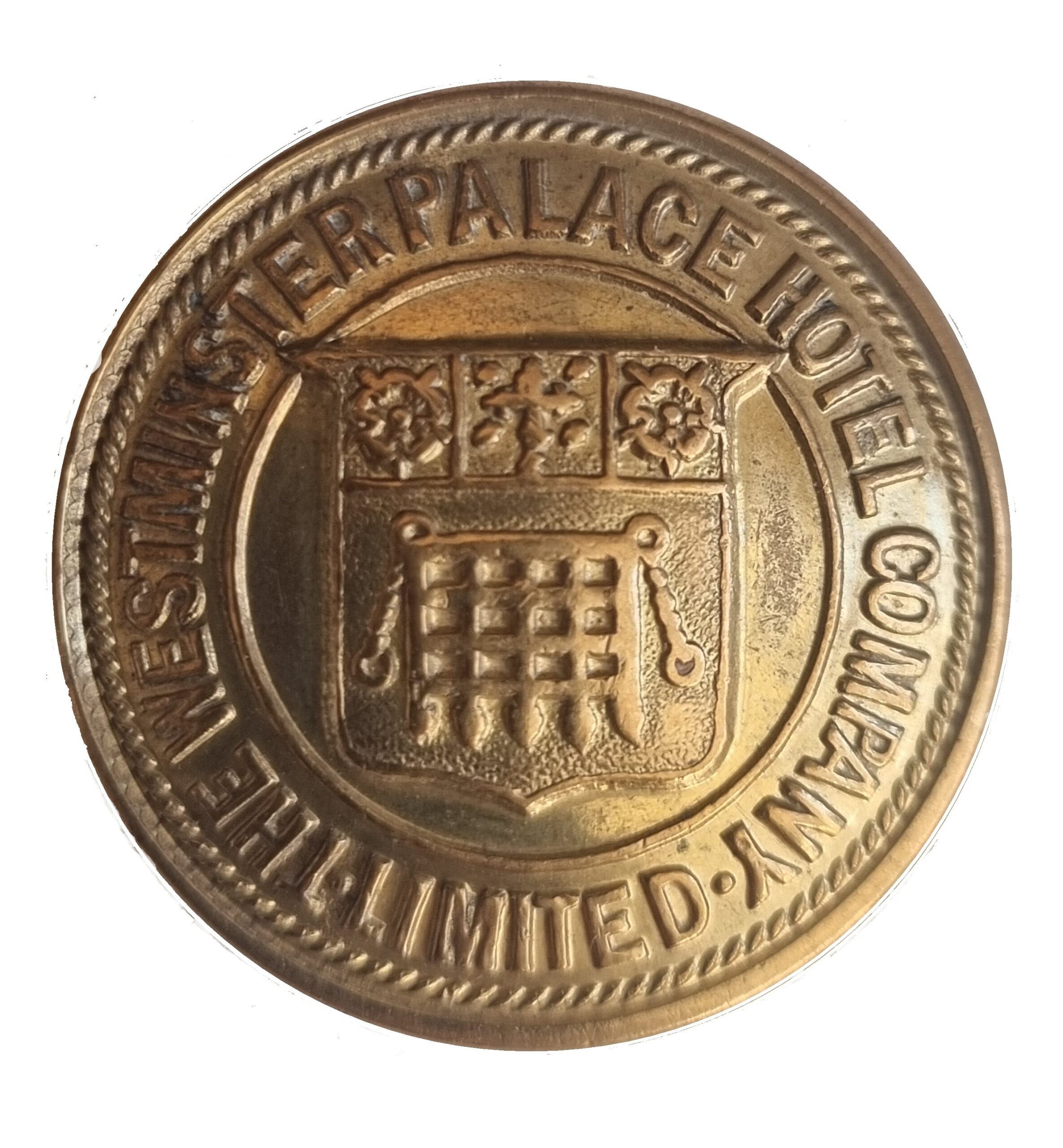
← Rare survivor: A button from the hotel uniform. Fewer staff than expected wore these from 1860 to 1867.
So, for seven years British India was governed from this dull Westminster hotel; a significant period in the history of the subcontinent, with reforming legislation reshaping government of the Raj, but also catastrophic famines in the Upper Doab and Orissa regions, leading to around 3 million deaths.
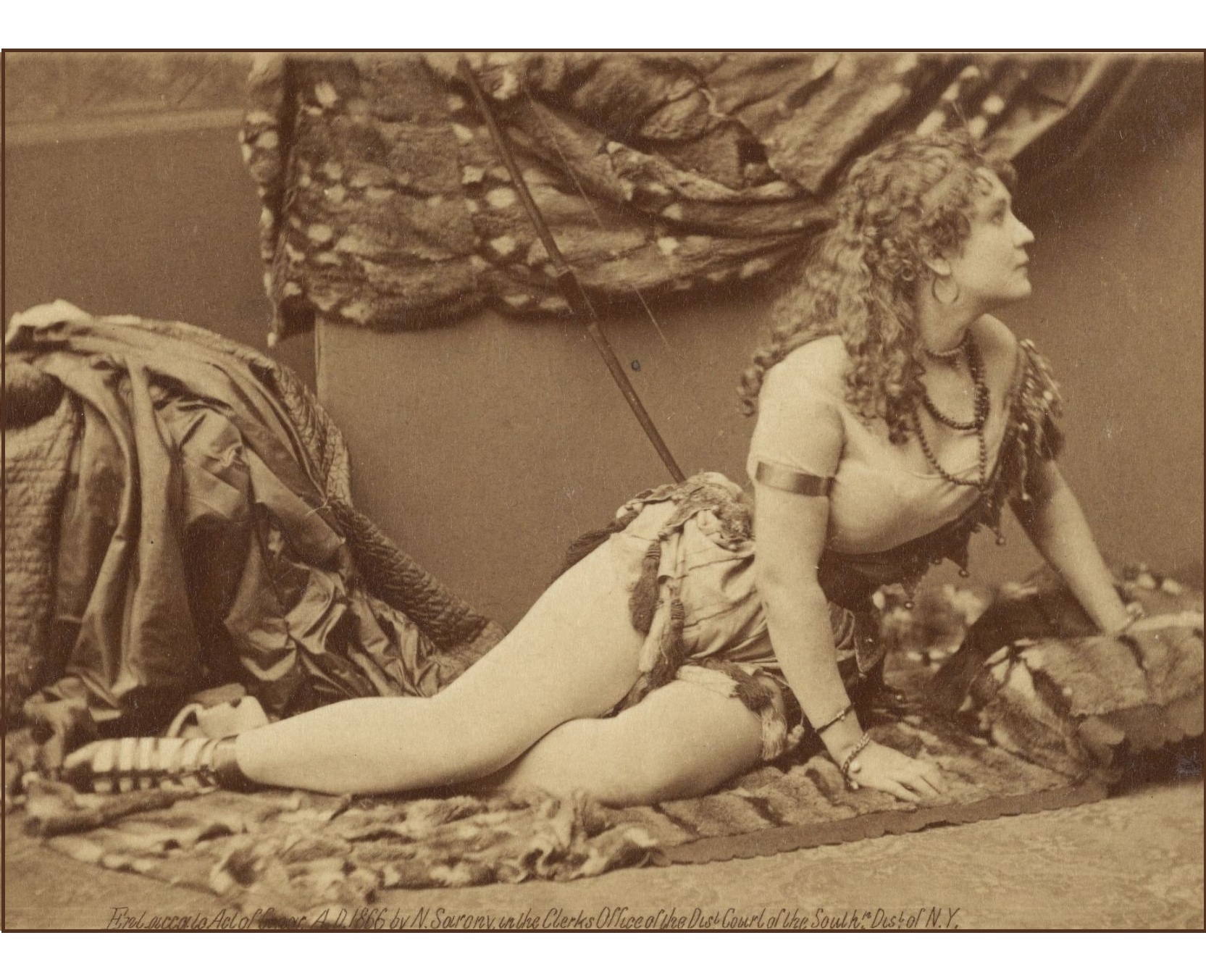
In almost grotesque contrast, we have Adah Isaacs Menken: American actress, painter, poet, bohemian. Her early life is a riot of confusion: Of mixed race, or maybe Irish, raised Catholic but of Jewish faith after her second marriage. Four husbands, supporter of controversial poet Walt Whitman (the support wasn’t reciprocated), lover of Charles Blondin. She scandalised London in 1864 by performing at Astley’s Amphitheatre in the spectacle Mazeppa strapped to a horse, seemingly naked though actually wearing pink leggings. Her acting wasn’t well-regarded, a review suggesting she was “delightfully unhampered by the shackles of talent”. Views on her writing were similarly withering. She returned in 1867; on both occasions she took a suite at the Westminster Palace, where she held a salon visited by Charles Dickens, to whom she dedicated a book of poetry, Algernon Swinburne and Dante Gabriel Rossetti. She died in Paris just a year later.
← Adah Menken in her most famous role
By comparison to such bizarrely incongruous occupants and activities, the hotel’s profitability seems unimportant, but I can report that along with income from the India Office, its central location brought in corporate business, for example AGMs of large companies, and various conferences, both political and commercial. Shareholders received a decent return on their investment. This despite unpleasant odours emanating from a tripe processing plant adjacent to the rear of the hotel along Tothill Street. That produced legal action in 1867.
In fact, 1866-7 proved to be quite an eventful period for the hotel. In its conference chamber, negotiations aiming to complete the process of bringing the constituent parts of Canada into a single country had reached agreement in principle on Christmas Eve 1866. These had been led by Sir John Macdonald, joint premier of the province of Canada (Ontario & Quebec) – though Sir John had also delayed them as he left North America several months late, allegedly due to his heavy drinking. Perhaps the same thing led to a candle igniting a chair in his Westminster Palace Hotel bedroom one night. He was sitting in it at the time and was seriously burned, but this time the talks were not delayed. The British North America Act was passed, a short walk away in Parliament, in March 1867, and the Dominion of Canada came into existence in July that year. Macdonald became the Dominion’s first Prime Minister. A commemorative mural was put up in the conference chamber.
The departure of the India Office at this time caused significant financial problems. The part of the hotel vacated couldn’t be relet immediately, indeed it remained empty for some time and dividends to shareholders were briefly suspended. Finally, in later 1868 the Royal London Yacht Club took some space as their new HQ, followed by the Victoria Chess and Whist Club, and the Society of Engineers, though methinks these did not bring in significant sums for the hotel. Once again staffing levels were reduced. An announcement in the Naval & Military Gazette in February 1869 indicated that part of the hotel was to be converted into chambers “for MPs and Gentlemen” – a curious differentiation. Rent would be one guinea per week and there were to be various ‘club’ rooms. By 1870 the hotel was in the red as it funded the alterations needed for the new chambers; an explosion set off when a waiter lit a gas lamp in a third floor sitting room couldn’t have helped; two members of staff were injured, a window blown into Victoria Street injuring a passing coal porter.
Shareholder discontent waned as profits returned, then surged. In 1880 a 12.5% annual dividend was declared, but a year later a stormy EGM heard claims that directors were paying dividends out of capital. Refurbishment and new management arrived in the early 1890s. Advertisements claimed “Electric Light throughout, … and all the latest modern improvements. Spacious Reading, Writing, Dining, Drawing Rooms and Hall Lounge, together with Smoking and Billiards Rooms are set apart for the convenience of visitors to the Hotel.” The key addition in the list was that new-fangled electricity.
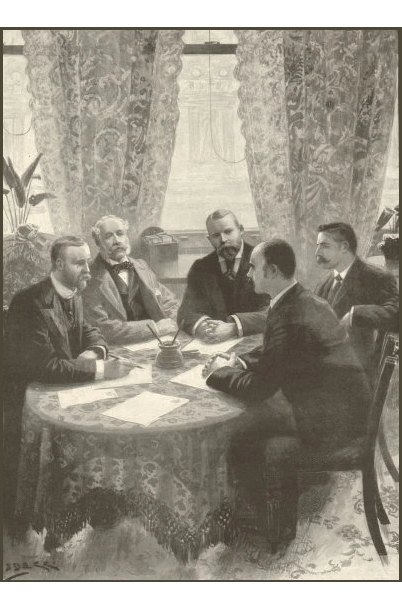
Given its difficult birth amid poor labour relations, there is a certain irony that secret negotiations between railway unions and the railway companies were held in the hotel; indeed, this became a theme, with striking engineers holding negotiations with employers at the same location in 1897 and the hotel eventually gained a reputation for hosting arbitration meetings.
← The engineering strike negotiations 1897.
The hotel also hosted many meetings of those in favour of Indian reform, including in 1907 a farewell breakfast for Dadabhai Naoroji, president of the Indian National Congress and former Liberal MP for Finsbury Central, before he returned to India. Soon after, Gandhi also stayed briefly at the hotel as he campaigned on behalf of the Transvaal Indians, and again a farewell meeting was held, with a resolution expressing ‘warm sympathy’. Allegedly, the room Gandhi stayed in had been, back in the 1860s, the office of General Sir Richard Vivian, a former adjutant general of the Madras Army and director of the East India Company, who moved seamlessly to the Council of India when the company was abolished. The modern statue of Gandhi in Parliament Square is just 200 metres from the site of the hotel.
Its life as a hotel ended abruptly in 1916. The National Liberal Club bought and occupied the hotel because their own clubhouse had been requisitioned by the Government. Their temporary home had two great advantages: Firstly, Liberal MPs could get over to the Commons in time to vote – if they hurried – as the ex-hotel had been fitted with a division bell. Secondly, it was considerably warmer than their clubhouse overlooking Embankment. There was one disconcerting disadvantage: Two or three women had chambers on leasehold from the hotel, and they refused to vacate until those leases expired. The club at that time was men-only.
The Liberals returned to their clubhouse in 1920, the older members no doubt with some reluctance, although the club did make a cool profit – reports range from £50,000 to £120,000 (£2m – £4.5m) – on the sale of the former hotel. Although initial reports suggested the building would return to its original purpose, the reality proved to be conversion into suites of offices, with shops on an unsympathetically altered ground floor. The conference chamber became a billiard hall. Much of the exterior decoration was removed, giving a vaguely art-deco look. The building was renamed Abbey House.
Surviving the Blitz more or less unscathed – its neighbour to the west was destroyed – it became the home to, among other organisations, the Conservative Party. They installed a fully equipped television studio on the third floor, ready for the media age, which was in stark contrast to the “gloomy aspect of the building … redolent of the nineteenth century” according to a visiting journalist. In an era known for redevelopment over restoration, talk like that suggested the building was close to the end of its useful life.
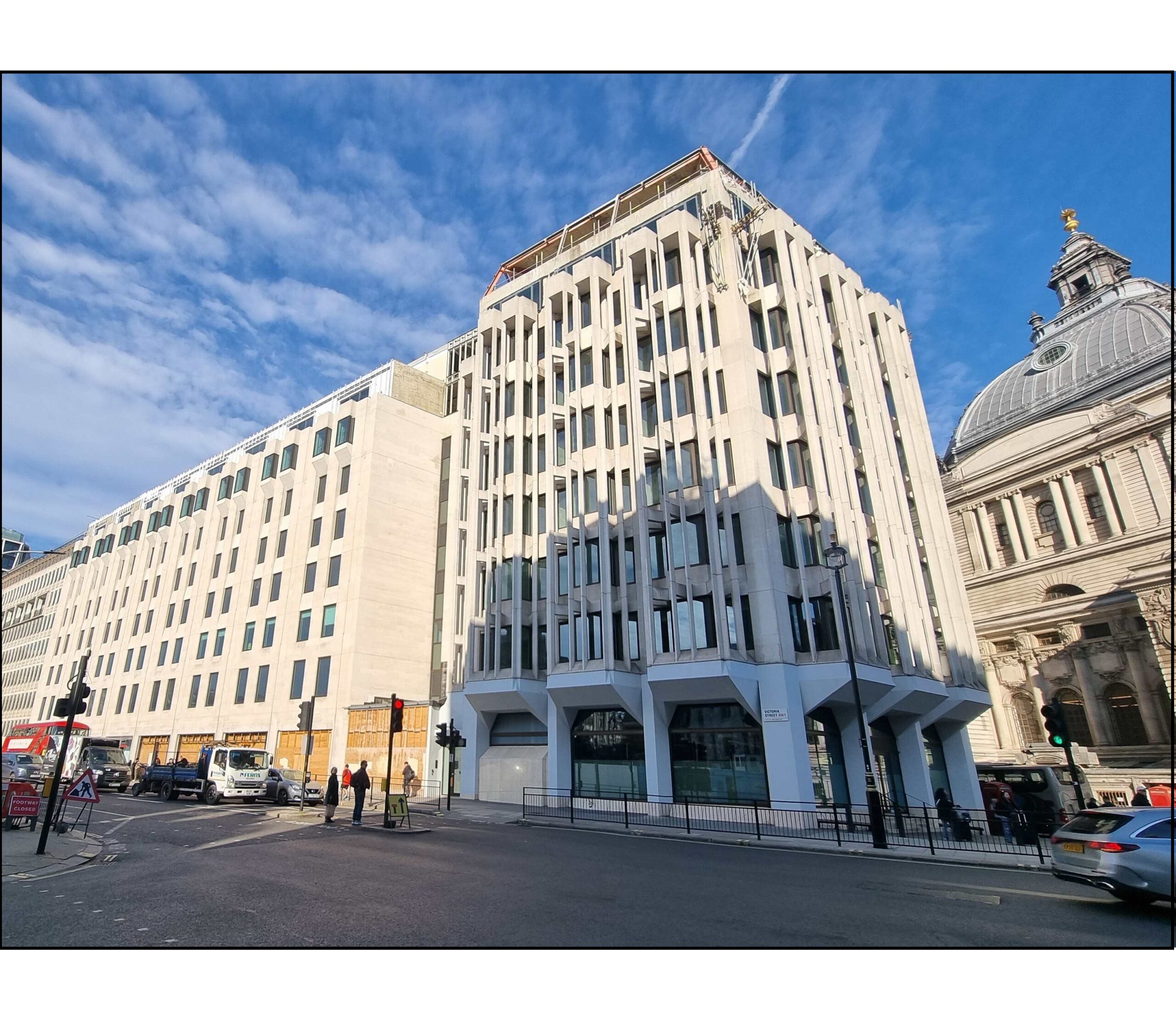
Rumours of demolition began circulating, leading to the pre-emptive departure of the Tories and another long-term tenant, the Boys’ Brigade. By the early 1970s the building was, according to the property company set to profit from redevelopment, crumbling. A spokesman commented: “Frankly, the old place had to go. It’s about time we had a nice building people took some notice of.” A mid-1970s office block replaced it. This may be many things but no-one is on record describing it as ‘nice’: The corner facing the abbey is the best part, featuring canted bays and stone fins echoing the perpendicular gothic style of the abbey and parliament; this is also set back from the original end of the hotel, providing more pavement space. The rest is simply dull.
← Now known as 4 Victoria Street, when the 1970s block got tired it was treated to a deep retrofit rather than demolition. The building to the right is the Methodist Central Hall, which played host to the first session of the United Nations General Assembly in 1946, instantly trumping the importance of all events in the hotel.
And that concludes the tale of the Westminster Palace Hotel. It stood for 114 years and in that time played an occasional walk-on, non-speaking role in the great drama of life that is the London metropolis. Its successor, I suspect, will not even have that modest destiny.
Nearest Stations:
Selected Bibliography:
Credits:
Categories: