
The end of the roaring twenties saw the rise of talkies but curiously, amid the resulting super-cinema building boom, the West End also experienced a mini-boom of theatre openings that peaked in 1930. Four of the playhouses opening that year are still with us. The fifth turned into a cine-variety disaster that bankrupted one of its developers. If you know anything of my style, you’ll already know which of the five I’ll be discussing here.
So, stand aside the Whitehall (now Trafalgar), Prince Edward, Cambridge and Phoenix theatres, as I examine the chequered history of what should have been a splendid new home for musical theatre called the Buchanan, on the south side of Leicester Square.
Impresario Sir Walter Gibbons (1871-1933), cinema pioneer, sometime actor, decorated war hero and chairman of the Royal Botanic Society, combined forces with actor Jack Buchanan (1890-1957) to build a playhouse with an entrance where St. Martin’s Street meets the square. It was to bear Buchanan’s name and include a flat for his use on the roof. However, after clearance of the site began, it became apparent that some plots of land needed for the large stage and backstage functions could not be secured. Time for a rapid rethink: The theatre was redesigned as a cine-variety house: A cinema in all but name, capable of hosting simple variety shows as part of an evening’s entertainment. A Wurlitzer organ was added, Buchanan got his roof-top pied-à-terre, and Hollywood studios in need of a flagship outlet for their movies began eyeing up the purpose-confused building.
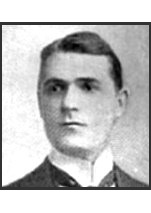
→ A young Walter Gibbons. If he could have foreseen the trouble his 1930 enterprise would cause him, he wouldn’t look so smug.
The building Gibbons and Buchanan couldn’t get their hands on was probably the Hand and Racquet pub, the name commemorating some real tennis courts once located nearby. It stood on the south western corner of the block and dated from 1866, although a previous incarnation had existed in Tudor times. Regulars in the 1960s included comedians Sid James, Tommy Cooper and Tony Hancock; indeed, the name appears as Hancock’s local pub in Hancock’s Half Hour.
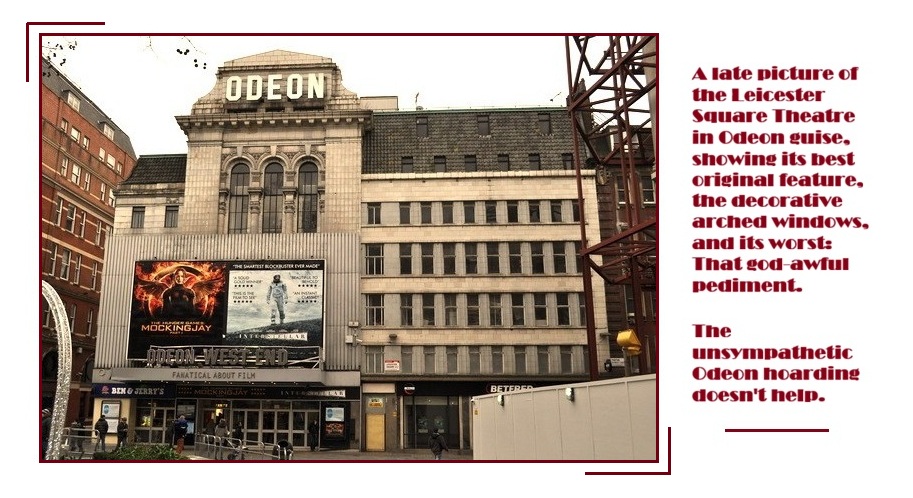
The pub survived and the theatre, so-called, was built. For those keen on architectural details – and there are such people, believe me – it was designed by Andrew Mather, also responsible for the office block on the square’s west side. The exterior was in a broadly classical style, faced with white faience tiling. Above the entrance were elegant arched windows ending in an ugly, badly-proportioned pediment. Critic Nikolaus Pevsner suggested the design lacked the conviction of its neighbours on the square, and I agree it had limited visual impact. The interior was – again broadly speaking – early renaissance. Capacity was a less-than-expected but still impressive 1,700 over three levels.
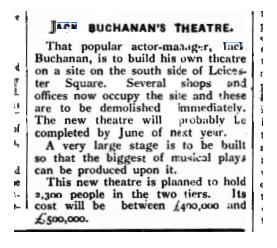
← The best laid plans: A 1929 issue of The Civil and Military Gazette reports to the British ex-pat population of Lahore, in modern-day Pakistan, what Jack Buchanan expected to happen in faraway Leicester Square. Completion date, capacity, stage size – all fiction.
Having set its investors back £250,000 (around £14.5m today) for the land alone, and been named the Leicester Square Theatre (‘LST’) at the last moment – as if they were in denial over what had happened – it got off to a bad start. Opening in December 1930 with a combined film and live dance show, it closed again quicker than a tap-dancer’s spank1. RKO then leased it for a year as the RKO Leicester Square Theatre, spending a lot of money on redesigning the interior and installing a stage revolve, which helped make up for the lack of space on the stage and in the wings. RKO presented shows with a 50/50 mix of film and live action: Gracie Fields’ Sally in our Alley was the first screen offering, with the Jack Hulbert song and dance show, The RKO Loud Speakers, on stage. But even after employing Wendell the New Wizard of the Wurlitzer and introducing a ‘reading and club room’ for patrons, RKO couldn’t turn a profit, and it didn’t renew its lease. County Cinemas then took the building for six months as the Olympic Cinema introducing popular – i.e. low – prices, but threw in the towel after just three months.
With that, the building resumed its original name and, from August 1932, jumped on the ‘non-stop variety’ bandwagon. This was a form of live entertainment, seemingly the saviour of theatres in the face of the ‘talkie’ onslaught, that the LST’s limited stage could accommodate. The Weekly Dispatch gave this news a mixed response, implying that the sixty chorus girls, ballet, and a stage crew of forty-two might be beyond its capabilities, but that an all-lady orchestra in the circle lounge, a Café Dansant, and a quiet writing room were less ‘variety’ and more ‘grand hotel’, which I think was a compliment. Sir Walter Gibbons presented his spectacular Non-Stop Revels every day from 2pm to midnight, tickets between one and five shillings. They were ongoing in February 1933, a month that brought two unrelated disasters: One for Sir Walter, the other for an unknown electrician, William Docking.
The main facts of the tragic case of ‘the drunken Peeping Tom’ are simple: Docking, 37, had spent part of the afternoon of the 2nd February drinking in the West End. By 4pm he was seriously drunk, according to one witness, or feeling unwell, according to his employer. He was next encountered at 9pm on the roof of the LST, the other side of the building to Buchanan’s flat, by a props manager, Mr. Parrett. He was, Parrett surmised, trying to look through windows of an adjacent hotel, the Plaza. Docking beckoned Parrett to come over but Parrett walked away in disgust. Docking was discovered at 10am the following day, dead, close to the back of the Plaza Hotel. He had fallen at some point in the night from the theatre roof, 50 ft above.
At the inquest, no legitimate reason could be found for Docking’s presence on the roof. It was surmised that he knew the layout of the building from having previously worked there, and the coroner damned him with his conclusion: “What is the natural inference in this case? … it is irresistible. [Docking] got on the roof. He had a dirty mind, and he thought he would gratify his lecherous instinct by peeping into the bedroom of the hotel. … He had no business on the roof.” A verdict of accidental death was recorded. As for Mr. Parrett, we have only his uncorroborated testimony describing what happened when he saw Docking. I for one am a tad suspicious.
At the time Docking met his death, Sir Walter Gibbons was counting the cost of his involvement in the LST. Along with other misguided business ventures, it had destroyed his wealth, and he surrendered the lease of the LST, allowing the building’s freehold owner to take over the variety show. He was then declared bankrupt at his own request, his petition implying he was living in the rooftop flat as Buchanan’s guest. Creditors first met on the same day as Docking’s inquest. They learned that Gibbons was overdrawn to the tune of £86,000 (£5.5m today) and owed creditors £25,000 (£1.5m). He had very few assets; further, he had undergone a serious medical procedure and would be unavailable to assist the creditors for several weeks. In fact, he never recovered and died in October.
By that time, the non-stop variety experiment had ended. Buchanan regained control, and leased the LST to United Artists (‘UA’). Their first release was That’s a Good Girl, starring …. Jack Buchanan. With this, the success that had proved so elusive finally arrived, and stayed. A spot of decorating mid-1937 caused a brief closure and was, with hindsight, a key moment. There were strong suggestions it would reopen as a variety theatre, which seemed wise given a huge, modern, luxurious cinematic rival, the Odeon Leicester Square, was about to open just metres away. However, it wasn’t to be. The cinema screen stayed firmly in position, and the stage was barely used again. Indeed, I suspect it was at this point that the auditorium boxes, six on each side and a leftover from thwarted theatrical ambition, were removed.
Despite its new rival, the success continued, although this was at least partly due to dubious business practices. A news story from 1939, just before the outbreak of war, reported on the experience of a doctor and his wife, respectable residents of East Ham. They had entered the lobby and, on being advised by both the commissionaire and box office staff that there was standing room only in the cheapest area, paid for two premium six-shilling seats, only to discover once in the auditorium that there were a number of empty seats in the cheaper area.
Suspecting malpractice, he opposed renewal of the cinema’s licence when it expired on Friday 30th June. Management excuses that those holding tickets for the empty seats were temporarily elsewhere in the building didn’t cut the mustard and the relevant London County Council committee refused immediate renewal, agreeing to grant a short-term licence from the following Monday, with the result that valuable weekend business was lost. It was meant as a rap on the knuckles, but the claim of Allan Eyles (2014), that it sent “shock waves throughout the British exhibition world” seems to stretch the point somewhat.
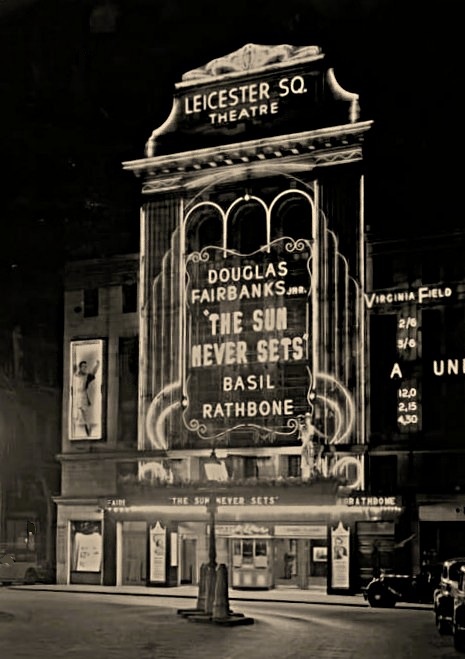
→ The film that opened after the LST regained its licence was The Sun Never Sets.
The LST did not escape the Blitz unscathed. In late October 1940 bombs took out Buchanan’s flat – it was never occupied again, being turned into storage – and closed the cinema for eight months. The damage wasn’t properly repaired – there were remedial works in both 1950 and 1955.
In 1943, an announcement suggested the venue would reopen as a theatre, bringing in Buchanan’s stage musical It’s Time to Dance which was then on a pre-West End national tour. The Evening News put this down to a shortage of West End theatres for the seventeen productions queuing up to come into the capital – by this time the old Shaftesbury, the Kingsway and the Queen’s had fallen to bombs. The plan was cancelled only weeks later, and It’s Time to Dance opened at the Lyric, Shaftesbury Avenue. Perhaps using the LST was a last resort and the Lyric – a better, more intimate space – became available.
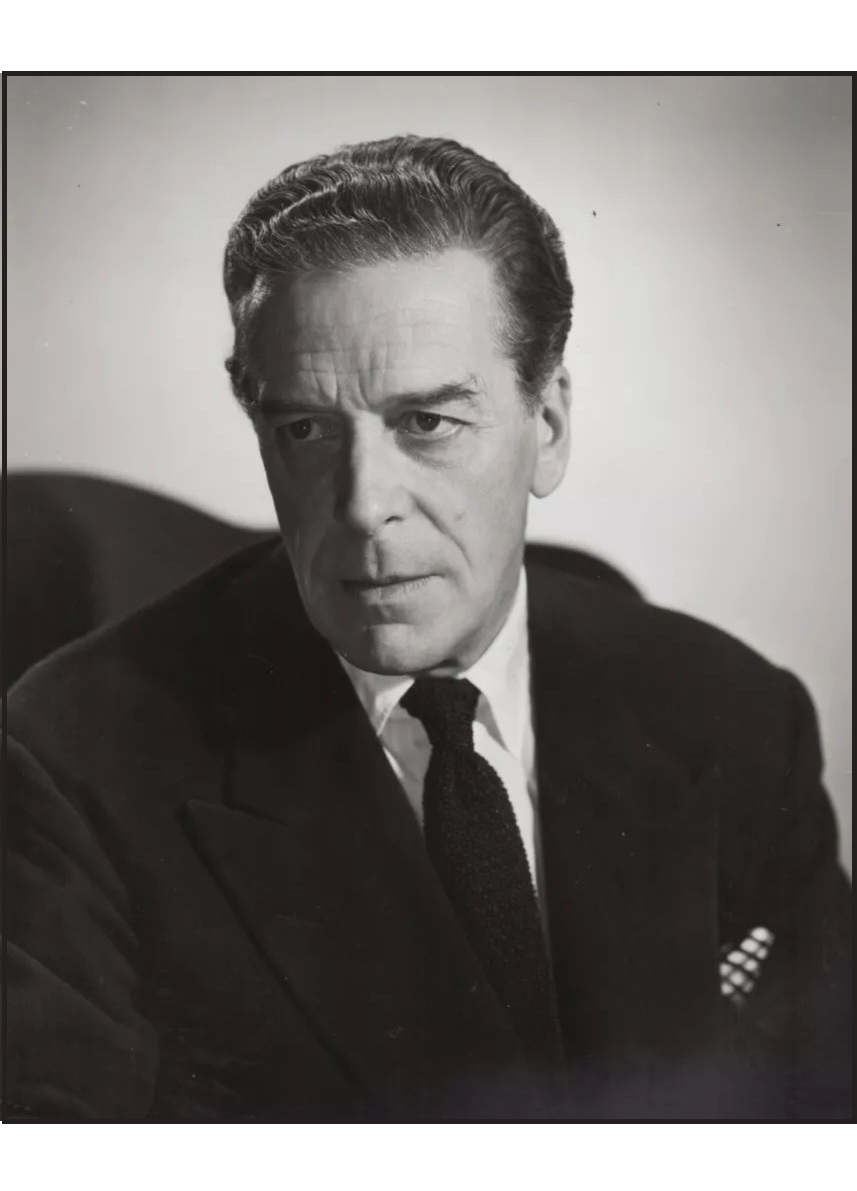
→ Jack Buchanan, at around the time he lost his Leicester Square pied-à-terre. This might explain the pained expression.
Also in 1943, there were more complaints to the licencing committee about dubious ticketing practices. In a variation of the previous technique, queues for cheaper seats were held by management for up to 30 minutes despite many such seats being available. At the same time, staff emphasised the ready availability of premium seats. This time the licence was renewed, with committee members concluding that the manager was doing his best to obey relevant laws, but that perhaps he needed a different approach. No rap on the knuckles this time, from councillors who strike me as rather naive.
From the involvement of UA onwards, the venue usually hosted US and UK blockbusters, with frequent gala film premieres. There were occasional outliers; I doubt there was any gala event for the March 1943 opening of Social Enemy No. 1, a US film on the scourge of syphilis. This was perhaps aimed at the thousands of American GIs in London, and London girls attracted to them. It did get a ‘foreword’ by Mr. Ernest Brown, Minister for Health, which I’m sure was riveting.
Jack Buchanan had leased the LST to General Film Distributors (‘GFD’) in 1937, and shortly after the war, GFD’s close links to J. Arthur Rank, who controlled Odeon, began dictating the site’s future; in 1946 it was transferred to Odeon’s control. Its location and quality Odeon programming ensured continued success, and it became the “second most desirable place to open a film among Rank’s West End group” (Ayles, 2005) – after, of course, its near neighbour the Odeon Leicester Square, the black marble-clad flagship of the chain. With such success, it’s a surprise to learn that Odeon tried – and failed – to sell the LST as a potential live music venue in the 1950s. A wide screen was then fitted, and in 1955 decorators once again spruced up the interior.
Thirteen years later that interior was completely rebuilt to the designs of Mannering and Steele at a cost of £285,000 (£4.5m today): The upper balcony was sealed off and all decorative plasterwork beneath that level removed. By the standards of the day the new auditorium was still huge, with a capacity of just over 1,400 and the plain decoration, by clever use of coloured lights and a vibrant range of coloured fabrics on the seats, could be described as funky. The screen was moved 50ft back, absorbing the stage area into the auditorium and ending any hope that some form of live show could return.
In the late 1960s and early 1970s the LST was often used as a ‘roadshow’ house, a curious term referring to a highly anticipated, blockbuster film being offered to the public on a premium, reserved seat basis rather like live theatre. While at the roadshow cinema, the film would not be shown at other cinemas in the Odeon chain. This could produce very long runs and very high profits. Only as business tailed off would the film get a wider release. However, the roadshow system fell out of favour in the early 1970s and by the end of the decade cinemas the size of the LST were rarely filled to capacity. These were the darkest days for British cinemas; Odeon began trimmed their West End estate yet the LST, defying all business logic, somehow still turned a profit and staggered on.
In 1986, it became the Odeon West End, finally losing that misleading ‘theatre’ moniker, a 56-year-old leftover from the ambitions of Gibbons and Buchanan. But the new name just added a whole new layer of confusion given the close proximity of the Odeon Leicester Square. At this time cinema was staging a modest recovery, often through clever use of twinning or tripling – subdividing cinemas into multiple, smaller auditoria. The LST was twinned in 1991, the balcony becoming Screen 1 and the stalls Screen 2. Total capacity was around 1,350 across the two screens; still too high by modern standards, and the twinning was badly executed, with some seats having poor views.
In 2005, the Odeon West End was sold to a private equity firm and leased back to Odeon. The writing was on the wall. This time developers, playing the long game, had made no mistake. Ownership of the entire block was secured, and with that the venue’s fate was sealed. Protests from English Heritage and other organisations2 – primarily regarding the collective street value and charm of the block as a whole – fell on deaf ears. The Odeon West End, the 149-year-old Hand and Racquet and the former Plaza Hotel all met with a wrecking ball in 2015.
The building that rose on the site houses a luxury hotel, with two small cinemas in the basement. Ultramarine faience tiles are used on the art deco-inspired exterior, particularly on the eye-catching tower-like cinema entrance. Branded as the Odeon Luxe West End; a ‘box-within-a-box’ approach was used to avoid sound penetration from the hotel.
Rowan Moore in the Observer described the building as “a generic, could-be-anywhere, lamely jazzed-up block, which suffers from the gaseous bloating of developments that try to squeeze too much profit-earning space on their site.” I take it he is not a fan.
→ The new Odeon Luxe West End in 2026, sharing the building with the Londoner hotel. The building to the right, although much altered, is by LST architect Andrew Mather.
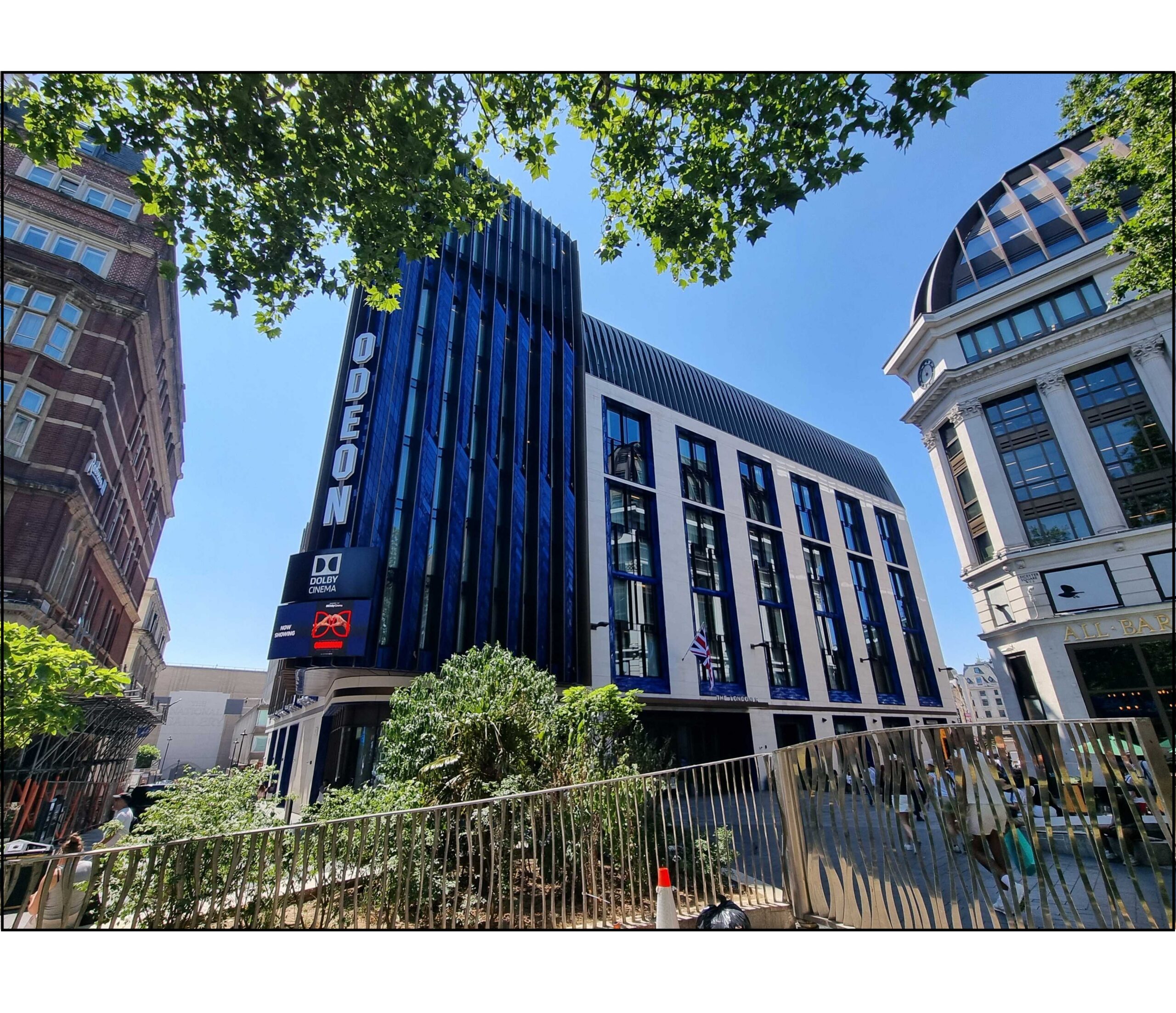
The total capacity of the two screens, which opened in 2021, is a mere 240. Despite the impressive corner treatment, the tiny capacity means there’ll be no more glamourous premieres here. The glory days of the location, such as they were, are gone.
Footnotes:
Nearest Stations:
Selected Bibliography:
Credits:
Themes: