
In 1906 and 1907 two theatres opened, positioned at either end of an island site facing Shaftesbury Avenue. The Hicks and the Queen’s, as they were initially named, were near-identical twins and had been designed – along with the building in-between housing a shoe business – by renowned theatre architect W.G.R. Sprague. So why, in 2026, do we have the Gielgud (ex-Hicks) in all its Edwardian splendour but the Sondheim (ex-Queen’s) staring onto the Avenue through a glass, mosaic and dark grey brick curtain wall?
I must begin with a short history lesson. Shaftesbury Avenue, a road development by the horrifically corrupt Metropolitan Board of Works linking Piccadilly to Holborn and designed specifically to sweep away swathes of Soho slums, opened in 1886. Despite ruining Piccadilly Circus, it was immediately seen by developers and impresarios as an ideal place for entertainment. By the turn of the 20th century, the rebuilt Royal Pavilion music hall and the new Lyric, Apollo, Shaftesbury1 and Palace theatres were all doing good business. Jack Jacobus, a shoemaker occupying part of a block between Rupert Street and Wardour Street on the north side of the avenue, noticed this success. With business associates including actor Seymour Hicks, he bought the entire block on an eighty-year lease and cleared the existing shops and warehouses. He replaced them with an enlarged, deluxe Jacobus premises (now Nos. 39-45) sandwiched between two new theatres, the Hicks and the slightly larger Queen’s. Jacobus was an exclusive, high-end establishment importing ladies’ shoes from Paris and Vienna.
W.G.R. Sprague had come hot-foot from designing another matching pair, the Strand (now Novello) and Aldwych theatres bookending the Waldorf Hotel on Aldwych. He was once articled to the great British theatre architect Frank Matcham, but where Matcham’s architectural style was flamboyant, outrageous even, Sprague was more controlled. The auditorium of the Queen’s, named after Queen Alexandra, was decorated in a fine Italian Renaissance style, that of the Hicks in Louis XVI style. The exteriors of both were in an overbearing Portland stone-clad style that architectural critic Nickolaus Pevsner labelled Robust Edwardian Baroque.
The first lessee of the Queen’s was J. E. Vedrenne, who proposed calling it the Central, “as if it were a criminal court or a railway terminus” wrote George Bernard Shaw. GBS – whose play The Apple Cart would get its London premiere at the Queen’s in 1929 – wasn’t the only critic of the proposal. It was thus no surprise that there was a last-minute change to the Queen’s in honour of Queen Alexandra, which prompted GBS to suggest that Vedrenne – a close friend – was after a knighthood.
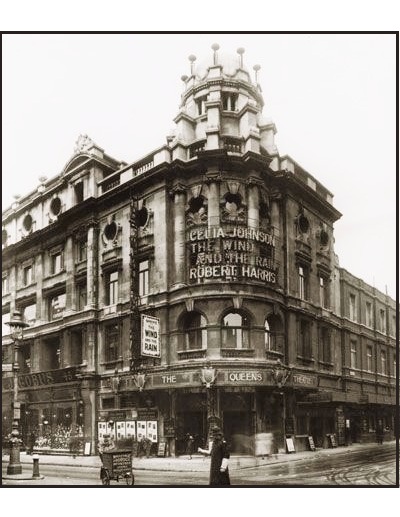
← The Queen’s Theatre in 1935. The Jacobus shoe emporium is on the left.
The opening play, the Sugar Bowl, was panned. Indeed, it took several years for the Queen’s to have any significant success, and Seymour Hicks considered his investment in the Queen’s, Hicks and Aldwych theatres a financial disaster, losing him £60,000 (north of £6m in today’s terms) within a few years. The initial failure can be put down to simple bad luck and poor judgement, but W. Macqueen-Pope (1888-1960), aka ‘Popie’, theatre publicist, historian, and a man who preferred glamour to academic research and hard facts, had a more left-field solution: He blamed the white, gold and green decorative scheme of the auditorium which, he alleged, gave an unfortunate pallid hue to female theatregoers’ faces, making them reluctant to return. Popie suggested business only improved when a new owner, Alfred Butt, redecorated in warmer tones. He would say that, as he was Butt’s business manager and probably proposed the revised colour scheme himself2. He also received some publicity that money couldn’t buy, when Alexandra’s daughter-in-law Queen Mary saw Dear Octopus (1938) twice in a week and stated that “I think it really excellent”.
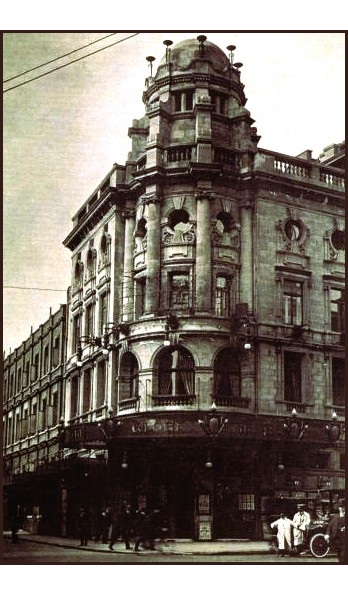
→ The Queen’s twin, probably from the early 1910s as the name on the canopy is the Globe – ‘Hicks’ was dropped in 1909. It became the Gielgud in 1994 to avoid confusion with Shakespeare’s Globe, about to open on the South Bank.
But this is getting us no nearer the story of why the façades are now so different. At least part of the answer lies – as you may have guessed – in the dark days of the Blitz. Late on the evening of 24 September 1940 a direct hit took out the lobbies and rear of the balconies in the auditorium. RAF aerial images from 1947 suggest the entrance façade, without its dome, was somehow left standing. The gallery (‘gods’) at the back of the grand circle was badly damaged, but suggestions that the grand circle was destroyed, or that the auditorium roof was completely blown off, seem unfounded. Destruction on that scale, experienced by places like the Holborn Empire and the Shaftesbury Theatre, could only end in complete demolition, a fate that did not befall the Queen’s.
Thankfully, the theatre was almost empty, the audience, actors and crew of a popular production of Daphne Du Maurier’s Rebecca, starring Celia Johnson and Margaret Rutherford, had already left for home in the blackout. There were just four injuries and no deaths.
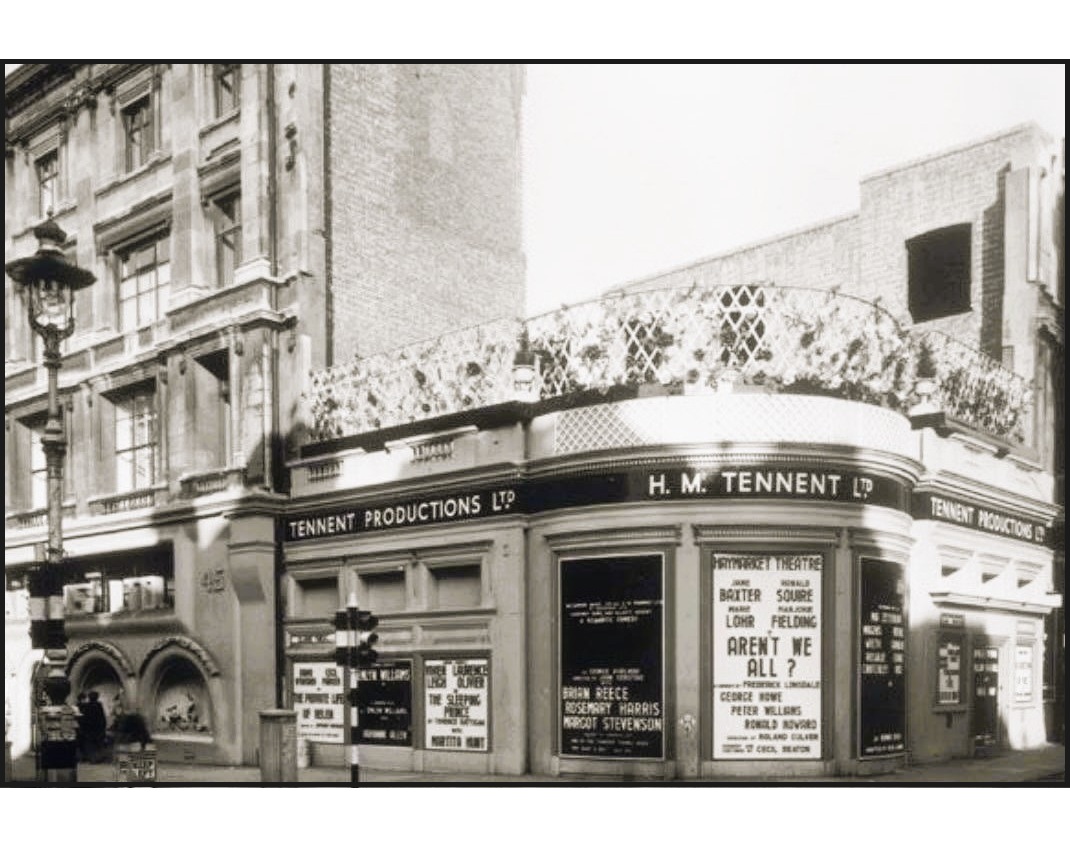
Most of the surviving Shaftesbury Avenue façade must have been demolished soon after war’s end as a safety precaution; only the ground floor walls were patched up, given a lick of paint and used to advertise plays put on by H.M. Tennant. The production of Rebecca so rudely terminated by the Luftwaffe was one of theirs. The auditorium was sealed off to all but the pigeons and rats.
← Advertisements for H.M. Tennant productions in 1953 on the surviving walls. The former lobby area behind these walls was still a bomb site. Right and above is the rear wall of the Queen’s auditorium. To the left, the extraordinary 1948 modernist ground floor frontage of Jacobus is just visible. This was designed by the manager T.D. Davis in white rendering. A clearer image of this in 1951 can be seen on the RIBA website here. By 1960 the design, and Jacobus, had gone.
It would take until 1957 for newspapers to report that the Queen’s would reopen. Government compensation finally came through, unspecified licencing issues were resolved, and sufficient additional funds raised for reconstruction. Bryan Westwood, of Westwood Sons & Co., was appointed architect, with Sir Hugh Casson advising on front-of-house decoration. This was a time when architecture was looking firmly forward; reconstructing the Edwardian façade wasn’t on the table and besides, the cost would have been prohibitive. Cost was also probably why the Edwardian auditorium, old-fashioned and ravaged by bomb, weather and vermin as it was, was retained. Preparatory work began in April, with the surviving 1907 ground floor remains to Shaftesbury Avenue cleared and the dust, rubble, guano, pigeons and rats evicted from the auditorium.
And so, a unique theatre frontage rose on the avenue. This new glass curtain-wall was designed to open up the bright lights of the avenue to those in the theatre bars, and vice versa. Panels between the windows are finished in dark ceramic mosaic and the flank to Wardour Street is of grey semi-glazed bricks. There was one vintage element hidden inside: Frosted glass panels in the new bars came from an old Notting Hill Gate pub.
Interestingly, the Theatres Trust Guide to British Theatres has rowed back on its opinion of this startling new addition, switching from a brutal 1982 assessment that it was “out-dated, untheatre-like, even heartless” to the more ambiguous “architectural gatecrasher, wearing the wrong suit to the party” in 2000. It seems the Trust has learned that criticism of a theatre could come back to haunt it when that theatre comes under threat of redevelopment and the Trust tries to protect it.
It would be wrong to say that this new front was simply tacked onto the old auditorium and everything given a spring clean and fresh lick of paint. In fact, a number of changes to the auditorium were considered necessary:
The project cost £250,000 (£5m today), and the new-look Queen’s triumphantly reopened with John Gielgud’s Ages of Man, a Shakespeare selection, on 2 July 1959. But there was one more peril to overcome, and it came rather sooner than anyone could have guessed.
Within weeks of the reopening, it was announced the now-not-so-identical twins were to be auctioned ‘with vacant possession’. Fears of demolition or conversion to retail were merited – the far more historic St. James’s Theatre had been lost to the wrecking ball just two years earlier – but in the event they went to theatre producer Prince Littler by private sale just before the auction. It was a close call, but the theatre hasn’t looked back since.
By 2019 it was in the hands of Cameron Mackintosh and in July that year Les Misérables closed temporarily so the Queen’s could undergo a £15m restoration, putting right some of the patched-up wartime damage: Balcony plasterwork was improved; postwar lighting on the upper balcony front was removed; a new chandelier in keeping with the original was fitted, and I trust the nylon flock wallpaper was consigned to history. There were significant improvements backstage.
→ The Sondheim Theatre in 2026. The flanking wall in red brick (to the right) is mainly original. The overwhelming Les Mis billboards do not compliment the 1959 structure.
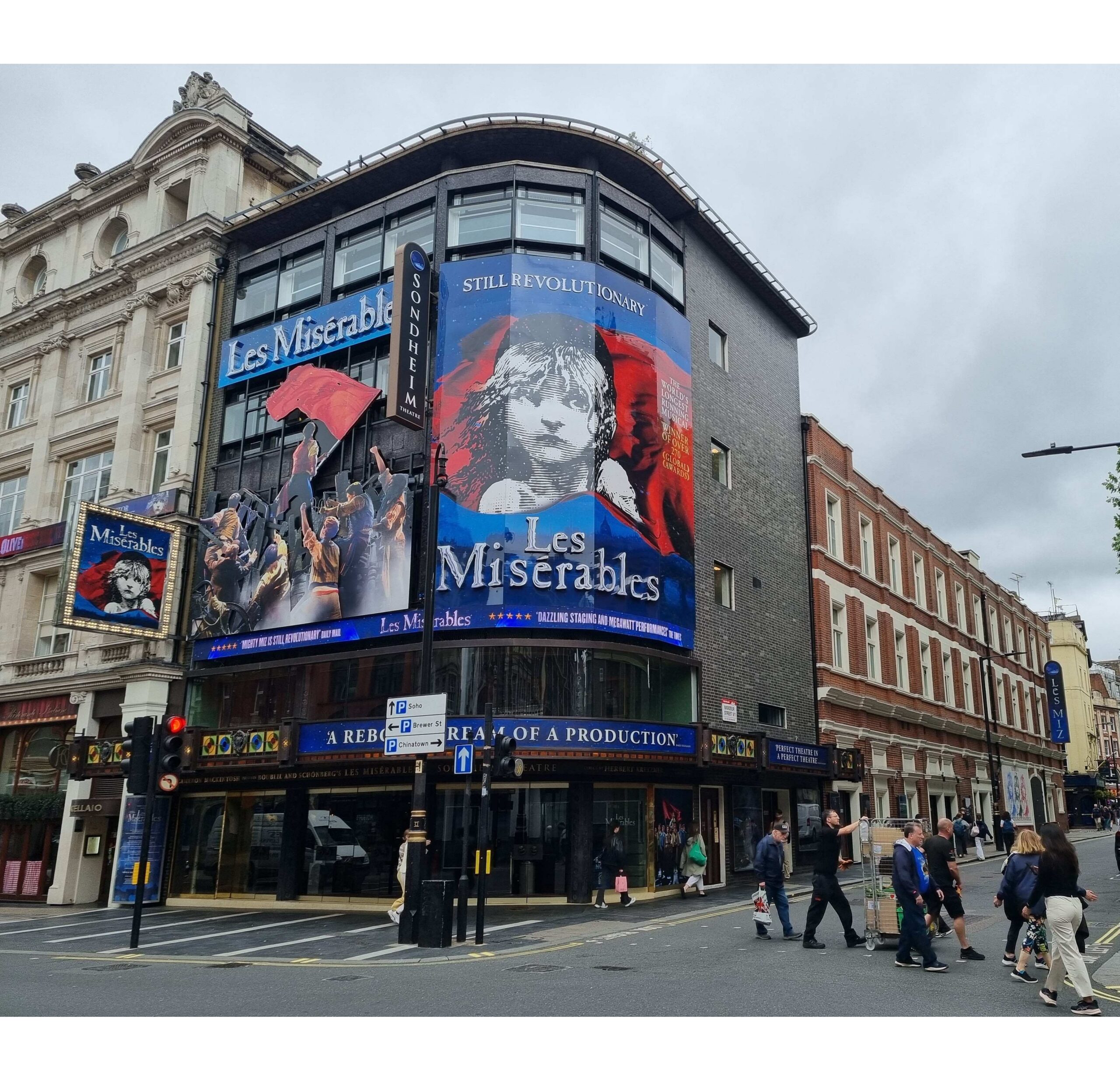
A new production of Les Mis reopened the renamed Sondheim Theatre just five months later, the new name being in honour of American composer and lyricist Stephen Sondheim.
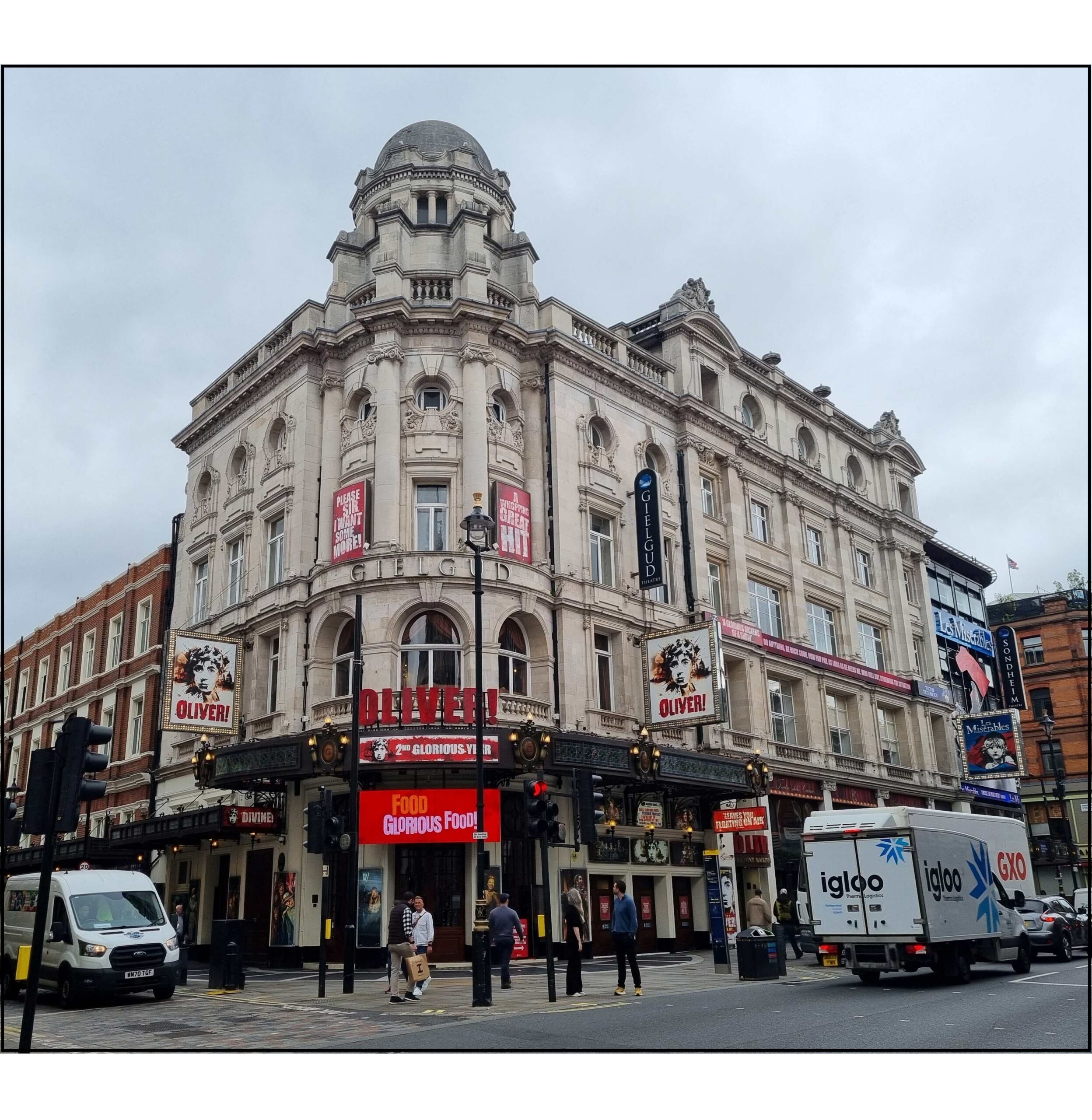
← The Gielgud and, beyond, the Sondheim in 2026. The Gielgud is much as it looked in 1906, with some minor loss of external decoration.
Are the twins ever likely to become identical again? It seems unlikely; the 1959 design is notable and Historic England considers it worthy of protection: The theatre is listed grade II and the listing includes a description of the 1959 works. Even if someone had enough spare change to fund such an extravagance as a reinstatement of the 1907 look, any such plan would likely fail to get planning consent.
Me? I go back to that 1982 description: “Out-dated, untheatre-like, even heartless”. I’d give planning consent without a second thought, but sadly I’m not on Westminster Council’s planning committee.
Nearest Stations:
Credits:
Selected Bibliography:
Footnotes
Topics Covered: